VA to Watts Calculator
Type the VA (or watts) and the power factor, and the formula gives the other number, with a table at other power factors.
Recent
Your last 10 settings, saved only in this browser. Nothing is uploaded.
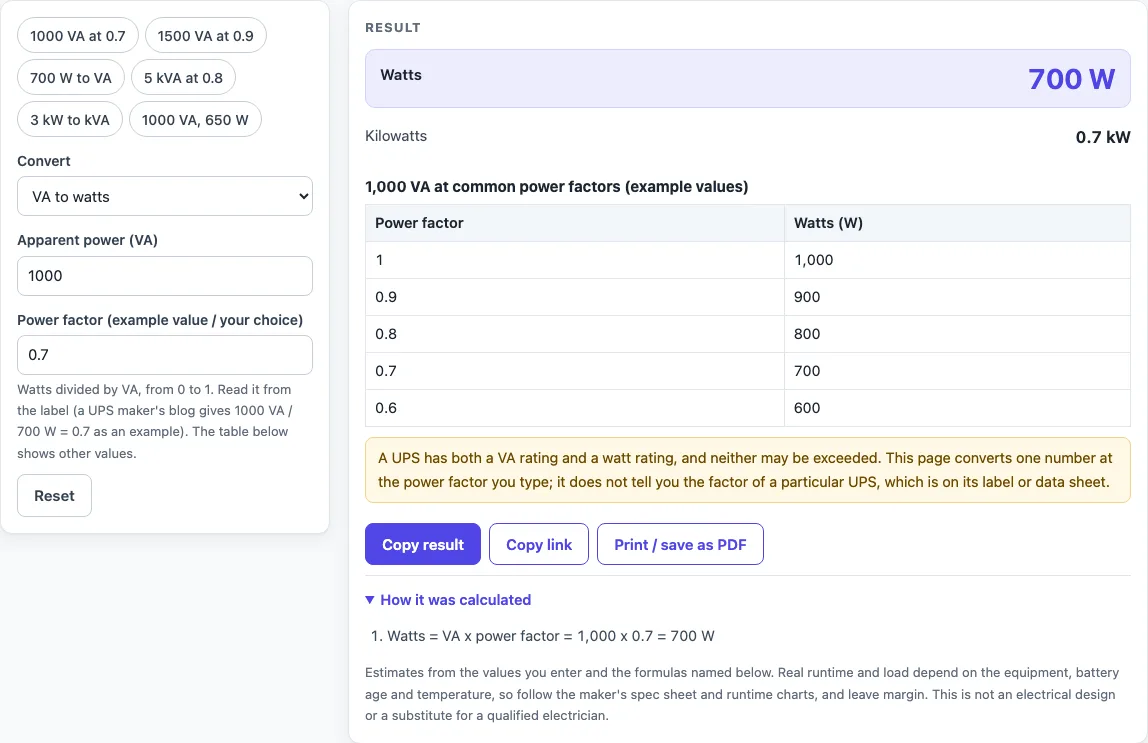
How to use the VA to Watts Calculator
- Open the “Convert” menu and choose a mode: “VA to watts”, “Watts to VA”, “kVA to kW”, “kW to kVA” or “Find the power factor from VA and watts”.
- Only the fields needed for your mode appear. For “VA to watts”, type a number in “Apparent power (VA)”.
- Type your power factor in “Power factor (example value / your choice)”. It must be above 0 and no more than 1. The help line says to read the factor from the equipment label.
- Read the large answer, “Watts” or “VA”. The “Kilowatts” or “Kilovolt-amperes” row shows the same result in kilo units (thousands).
- In “Find the power factor from VA and watts” mode, type “Apparent power (VA)” and “Real power (W)”. The “Power factor” row shows the result.
- Check the table, which shows the same input at power factors 1.0, 0.9, 0.8, 0.7 and 0.6, plus your own factor when it is different.
- Read the warning above the results. It always reminds you that a UPS has both a VA rating and a watt rating, and that neither may be exceeded.
Presets appear as chips you can click: “1000 VA at 0.7”, “1500 VA at 0.9” (1350 W), “700 W to VA”, “5 kVA at 0.8” (4 kW), “3 kW to kVA” and “1000 VA, 650 W”. If a value is empty, is text, is 0 or less, or the power factor is 0, negative or above 1, the tool shows an error instead of a result.
What is the formula for converting VA to watts?
Watts equal VA multiplied by the power factor: W = VA x power factor. Kilo means 1000, so kW = kVA x power factor works the same way. For example, 1000 VA x 0.7 = 700 W, which is also 0.7 kW.
What is a power factor?
The power factor is a number that links VA to watts. It is always above 0 and at most 1. A UPS maker’s blog describes it as watts divided by VA, from 0 to 1, and gives 1000 VA and 700 W as an example, which is a factor of 0.7.
How do you find the power factor from VA and watts?
Divide watts by VA: power factor = W / VA. For example, 650 W on 1000 VA gives a power factor of 0.65. Watts cannot be higher than VA, because the factor cannot exceed 1, so the tool flags that case. The reverse also works. For 450 W at a 0.6 factor, VA = 450 / 0.6 = 750 VA, or 0.75 kVA.
Which power factor should you use?
The UPS maker’s blog gives 0.7 as its example, not as a typical value, and no single typical factor is stated here. Other values such as 0.8, 0.9 or a “60% of VA” rule were not confirmed on a page read for this tool, so this page does not rely on them. Use the figure on your equipment’s label, or the spec sheet from the maker. The table shows how the result changes across several factors.
How do kVA and kW convert?
The same factor works in thousands. In “kVA to kW” mode, kW = kVA x power factor, so 5 kVA at 0.8 is 4 kW, which is 4000 W. In “kW to kVA” mode, kVA = kW / power factor, so 3 kW at 0.8 is 3.75 kVA. The page shows the answer in “Kilowatts” or “Kilovolt-amperes” under the large result.
What does the table of power factors show?
Under the result, a table repeats your input at the power factors 1.0, 0.9, 0.8, 0.7 and 0.6. These are example values; only 0.7 comes from the blog. For 1000 VA the rows read 1000, 900, 800, 700 and 600 W. If your own factor is a different number, such as 0.65 from 650 W on 1000 VA, the table adds a row for it.
Why does a UPS have two ratings?
The UPS maker’s blog says a UPS has both a VA rating and a watt rating, and neither may be exceeded. It also says the UPS watt capacity should be 20-30% above the connected total, and that the VA rating should be checked too. This page converts one number at the power factor you type. It does not tell you the factor of a particular UPS, which is on its label or data sheet. Three-phase conversions need a line voltage and a different formula, and are not covered.
Sources (checked 16 October 2026): cyberpower.com
Worked examples
| Input | Result |
|---|---|
| 1000 VA, power factor 0.7 | 700 W |
| 1500 VA, power factor 0.9 | 1,350 W |
| 450 W, power factor 0.6 | 750 VA |
| 5 kVA, power factor 0.8 | 4 kW |
| 1000 VA and 650 W | power factor 0.65 |
Calculated by the tool above; open it with the same values to see each step.
Frequently asked questions
Does the VA to watts calculator upload what I type?
No. It runs in your browser and nothing you type is uploaded.
What power factor should I enter?
Use the value from your equipment’s label or the maker’s spec sheet. The page does not know the power factor of any particular UPS.
Why is my watt result lower than my VA rating?
Watts equal VA multiplied by a power factor between 0 and 1, so the watt figure is lower unless the factor is 1.
Can I convert kVA to kW?
Yes. Choose “kVA to kW” and enter kilovolt-amperes. Multiply by the power factor to get kilowatts, because kilo means 1000.
What if watts are higher than VA?
The factor would be above 1, which is not possible. In “Find the power factor from VA and watts” mode, the page says so.
Why does a warning appear when the factor is under 0.5?
A factor under 0.5 is unusual, so a second warning reminds you that the VA and watt values may have been swapped. Check your inputs.
Does the table use typical power factors?
No. The factors 1.0, 0.9, 0.8, 0.7 and 0.6 in the table are example values, and only 0.7 comes from a source, a UPS maker’s blog. The page states no typical factor.
Does it convert three-phase power?
No. Three-phase conversions need a line voltage and a different formula, and the tool does not cover them.
Related tools
- UPS Battery Calculator: Use it when you want to estimate battery needs for a backup power setup.
- UPS Runtime Calculator: Use it when you want to estimate how long a UPS can run a load.
- UPS Sizing Calculator: Use it when you want to compare a UPS size with the load it must support.
- UPS and Backup Power: the hub with every UPS and backup power tool on this site.
- Home Theater Equipment List Generator: use it when you want a list of your devices with their watt totals to convert.
- PoE Power Budget Calculator: use it when the load is PoE gear and you need its total watts.