UPS Battery Calculator
Say how long you want to run a load, choose the bank voltage and the battery size, and see the capacity and battery count the formula gives.
Recent
Your last 10 settings, saved only in this browser. Nothing is uploaded.
How to use the UPS Battery Calculator
- Type your load in watts into “Load (W)”.
- Enter the time you need in “Runtime you want (minutes)”. The default is 60.
- Choose your “Battery bank voltage (V)”: 12 V, 24 V or 48 V.
- Enter “Voltage of one battery (V)”. The bank voltage must be an exact multiple of this value.
- Enter “Capacity of one battery (Ah)” for the battery you plan to buy.
- Open More options and check “Inverter efficiency (%, example value / your choice)” and “Usable share of the battery (%, example value / your choice)”. Both default to 80%, which are example values you can change.
- Read the first rows of the result: “Battery capacity needed at the bank voltage”, “Batteries to buy”, “Battery energy needed”, “Batteries in series per string” and “Strings in parallel”.
- Compare them with “Bank capacity you would have”, “Bank energy you would have” and “Runtime with that bank” to see what your chosen batteries provide.
- If an error appears, correct the input. Errors cover a bank voltage other than 12, 24 or 48, a bank that cannot be built in series from your battery voltage, zero or text values, and efficiency or usable share above 100%.
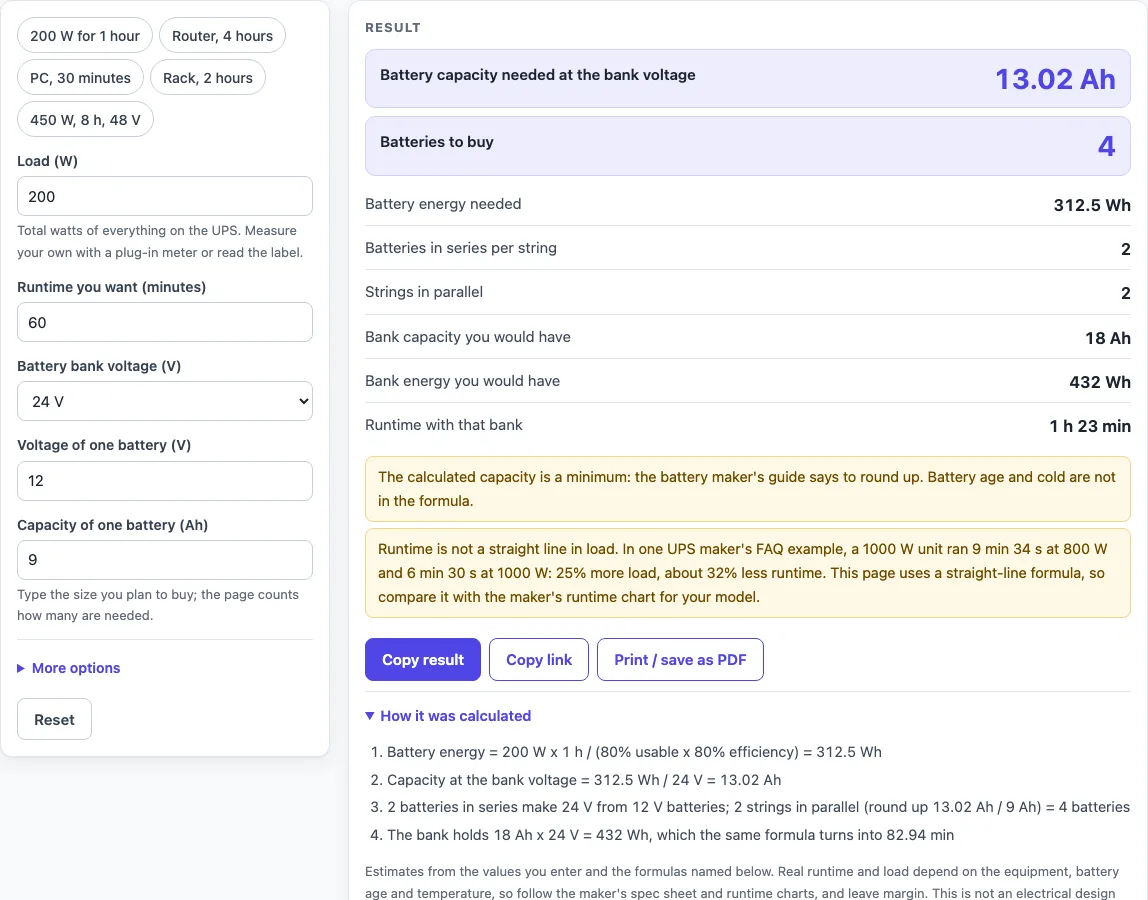
The preset chips fill the inputs for common cases: “200 W for 1 hour”, “Router, 4 hours”, “PC, 30 minutes”, “Rack, 2 hours” and “450 W, 8 h, 48 V”. Pick one, then change any value to match your own equipment.
How do you work out the battery energy a UPS needs?
Battery energy in watt-hours equals load in watts times hours, divided by the usable share and the efficiency. The calculator uses Wh = load W × hours ÷ (usable share × efficiency). Dividing by efficiency allows for power lost between the battery and the load, and dividing by usable share leaves a margin so the battery is not drawn down fully. With the defaults of 200 W, 60 minutes, 80% efficiency and 80% usable, the result is 312.5 Wh.
How many amp-hours does a battery bank need?
Divide the watt-hours by the bank voltage: Ah = Wh ÷ bank V. For the defaults, 312.5 ÷ 24 gives 13.02 Ah. With usable share at 100%, the same calculation matches the battery maker’s sizing guide formula, Ah = (W ÷ efficiency ÷ V) × hours. That guide gives 89.29 Ah for 450 W over 8 hours at 84% efficiency on a 48 V bank. The guide has no depth-of-discharge factor, while this page adds a usable-share input with an 80% example default because the other sources give no figure. Set usable share to 100% to follow the guide, or lower it to build in a larger margin.
How do series and parallel batteries set the bank size?
Batteries in series equal the bank voltage divided by one battery’s voltage, and this must divide exactly. Strings in parallel equal the Ah needed divided by one battery’s Ah, rounded up. Total batteries are series × parallel. Series adds volts and parallel adds amp-hours. For example, 100 W for 2 hours at 100% efficiency and 100% usable on a 12 V bank needs 200 Wh, or 16.67 Ah. With 7 Ah batteries, ceil(2.38) gives 3 strings in parallel, which is 21 Ah. An exact fit is not rounded up: 120 W for 1 hour at 100% and 100% on 12 V needs exactly 10 Ah, which is 2 strings of 5 Ah. The battery maker’s guide describes the calculated Ah as a minimum to round up.
Why does UPS runtime not scale in a straight line with load?
Runtime does not fall in direct proportion to load. A UPS maker’s FAQ gives 9 min 34 s at 800 W against 6 min 30 s at 1000 W on a 1000 W unit. The calculator’s runtime rows use the energy formula, so they are a linear estimate from your inputs. Follow your equipment maker’s spec sheet for runtime at your actual load.
What does the calculator leave out?
The calculator does not model battery age, temperature, battery life in years or Peukert effects. The usable share is your own margin, not a figure from a source. Allow for these factors yourself when choosing a bank size.
Sources (checked 16 October 2026): enersys.com · se.com · phys.libretexts.org
Worked examples
| Input | Result |
|---|---|
| 200 W for 60 min, 24 V bank, 12 V 9 Ah batteries | 13.02 Ah needed: 2 in series x 2 in parallel = 4 batteries |
| 450 W for 480 min, 48 V bank, 12 V 100 Ah batteries | 89.29 Ah needed: 4 in series x 1 in parallel = 4 batteries |
| 60 W for 120 min, 12 V bank, 12 V 26 Ah batteries | 15.62 Ah needed: 1 in series x 1 in parallel = 1 batteries |
| 500 W for 30 min, 24 V bank, 12 V 35 Ah batteries | 16.28 Ah needed: 2 in series x 1 in parallel = 2 batteries |
Calculated by the tool above; open it with the same values to see each step.
Frequently asked questions
Does the UPS battery calculator upload my numbers?
No. It runs in your browser, and nothing you enter is uploaded.
Why does the result ask for “Batteries to buy” when I expected one battery?
The batteries needed depend on the bank voltage and amp-hours. If your bank needs more amp-hours than one battery provides, strings are added in parallel, and the total is series × parallel.
Can I use 12 V batteries in a 24 V bank?
Yes, two 12 V batteries in series make 24 V. A bank that cannot be built from your battery voltage in series, such as a 12 V bank from 24 V batteries, shows an error.
Are the 80% efficiency and 80% usable share correct for my system?
They are example values set as defaults. The 80% efficiency is the figure the battery maker’s guide assumes when the UPS is at least 40% loaded. Change both values to match your equipment’s spec sheet.
Does the calculator account for battery age?
No. Battery age, temperature, battery life in years and Peukert effects are not modelled, so the output reflects only the inputs you enter.
What does “Runtime with that bank” tell me?
It shows the runtime that the bank you would have, using the same formula, gives for your load. It is a calculated figure from your inputs, not a guaranteed run time.
What does the default example give?
200 W for 60 minutes with 80% efficiency and 80% usable needs 312.5 Wh, which is 13.02 Ah on a 24 V bank. With 12 V 9 Ah batteries that is 2 in series and 2 strings in parallel, 4 batteries. That bank holds 432 Wh and the same formula gives 82.9 min (1 h 23 min).
Related tools
- UPS Runtime Calculator: use it when you already have a battery and want to see how long it will run a given load.
- UPS Sizing Calculator: use it when you are choosing how much UPS capacity your equipment needs.
- VA to Watts Calculator: use it when a device label or spec lists apparent power in VA and you need watts.
- UPS and Backup Power: the hub with every UPS and backup power tool on this site.
- Home Theater Equipment List Generator: use it when you want a list of your devices with their watt totals before you plan a battery.
- PoE Power Budget Calculator: use it when the load is PoE gear and you need its total watts.