40 Inch TV Dimensions
Type a diagonal (it opens at 40 in) and a screen shape to see the width, height and area of the screen, plus viewing-distance and mounting-height figures from named sources.
Recent
Your last 10 settings, saved only in this browser. Nothing is uploaded.
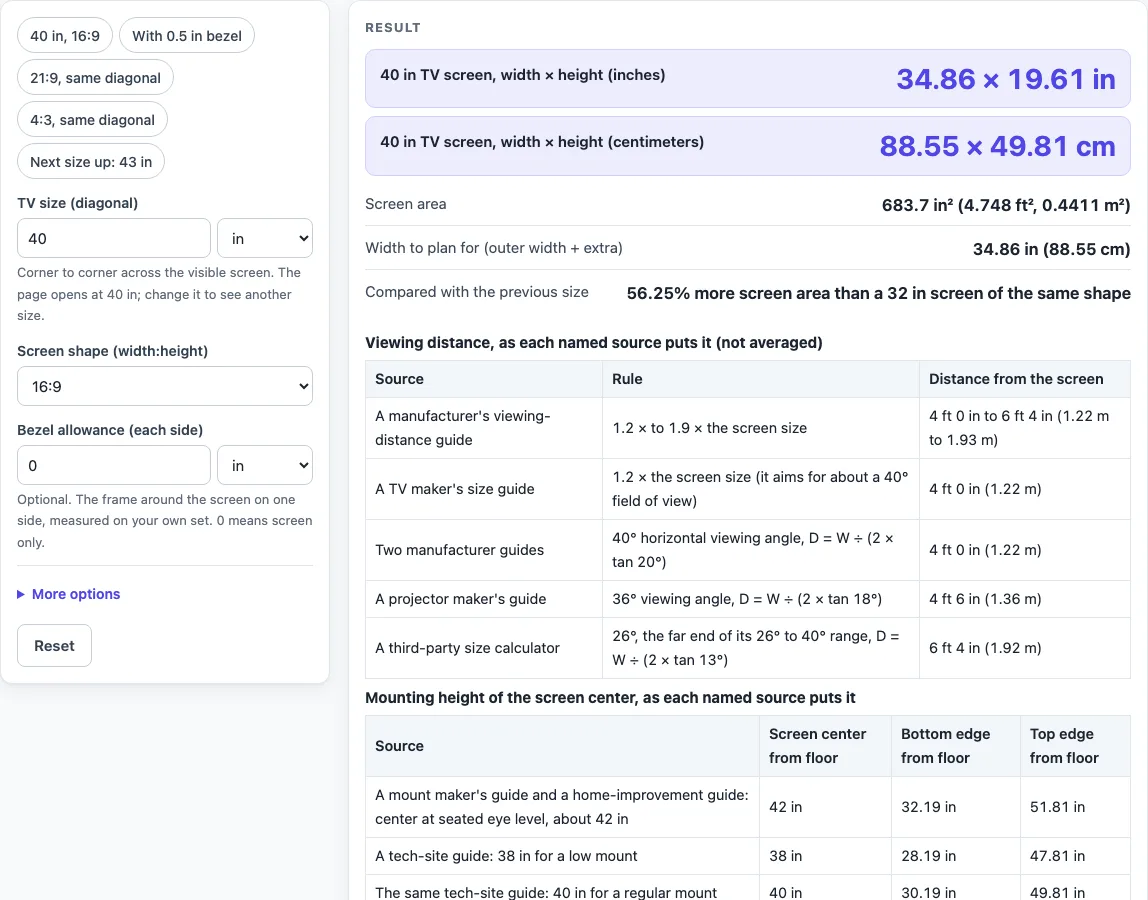
How to use the 40 Inch TV Dimensions tool
- Open the page. It starts at a 40 in diagonal in the 16:9 shape, so the default result appears straight away: 34.86 × 19.61 in (88.55 × 49.81 cm).
- Set “TV size (diagonal)” to the size you are checking. You can enter it in in, cm, mm or ft. Leave it at 40 in to see this size.
- Choose a “Screen shape (width:height)”. The options are 16:9 (the default), 21:9 (treated as exactly 21:9), 4:3 and 16:10. For any other ratio, pick the custom option and fill in “Shape, width part” and “Shape, height part”.
- Enter a “Bezel allowance (each side)” if you want a frame included. At 0.5 in, the page adds twice that amount to the width and height and shows the “Outer size with your bezel allowance” row. With 0 that row stays hidden.
- Open More options and type an “Extra width for stand or cabinet”. The “Width to plan for (outer width + extra)” figure updates. The page does not know your set’s feet, so enter the stand width yourself.
- Read the screen area, the viewing-distance table and the mounting-height table. Then compare the figures with your set’s own measurements.
The presets are “40 in, 16:9”, “With 0.5 in bezel”, “21:9, same diagonal”, “4:3, same diagonal” and “Next size up: 43 in”. Each one fills in the controls for that case, so you can switch between common setups quickly.
How are 40 inch TV dimensions calculated?
The width and height come from the diagonal and the screen shape, using Pythagoras’ rule that diagonal² = width² + height². For a shape a:b, width = diagonal × a ÷ √(a² + b²) and height = diagonal × b ÷ √(a² + b²).
For 16:9 at 40 in, √(16² + 9²) = √337, which is about 18.36. The width is 40 × 16 ÷ 18.36 = 34.86 in, and the height is 40 × 9 ÷ 18.36 = 19.61 in. The screen area is width × height, which gives 683.7 in². That is 4.748 ft² or 0.4411 m².
The shape changes the result even when the diagonal stays the same. A 40 in screen in 21:9 measures 36.77 × 15.76 in, and in 4:3 it measures 32 × 24 in. A wider shape gives a shorter screen for the same diagonal.
Area grows faster than the diagonal. A 40 in screen in the same 16:9 shape has 56.25% more area than a 32 in screen, because area scales with the square of the diagonal.
Why does a 40 inch TV often measure larger or smaller than its label?
The published figures describe only the visible screen. A frame or bezel adds to the outside size, and so does a stand. With a bezel allowance of 0.5 in on each side, the outer size becomes 35.86 × 20.61 in (91.09 × 52.35 cm). The “Width to plan for” figure adds any extra stand width you type, but depth is not calculated because it depends on the model, the stand or wall mount, and the connections.
A label size can also differ slightly from the real screen. A reference page says class sizes should be within 1/2 in of the actual size, and a retailer’s guide gives a 55-class screen of about 54.6 in as an example. The page states this in a warning and does not correct for it.
No published width and height for exactly 40 in was read, so no published figure appears beside the calculation for this size. The 40 in size was also only seen listed in search results, not confirmed on a page we read, and the geometry is the same either way.
Sources (checked 16 October 2026): support.tcl.com · blog.bestbuy.ca · en.wikipedia.org · samsung.com · us.dynabook.com · benq.com · blog.sanus.com · bobvila.com · slashgear.com · nist.gov · blog.bestbuy.ca · samsung.com
Worked examples
| Input | Result |
|---|---|
| 40 in diagonal, shape 16:9 | 34.86 × 19.61 in (88.55 × 49.81 cm) |
| 40 in diagonal, shape 16:9 | 34.86 × 19.61 in (88.55 × 49.81 cm) |
| 40 in diagonal, shape 21:9 | 36.77 × 15.76 in (93.39 × 40.02 cm) |
| 40 in diagonal, shape 4:3 | 32 × 24 in (81.28 × 60.96 cm) |
| 43 in diagonal, shape 16:9 | 37.48 × 21.08 in (95.19 × 53.55 cm) |
Calculated by the tool above; open it with the same values to see each step.
Frequently asked questions
What are the dimensions of a 40 inch TV?
At the standard 16:9 shape, the visible screen is 34.86 × 19.61 in (88.55 × 49.81 cm). The screen area is 683.7 in². These figures are calculated from the 40 in diagonal.
Does a 40 inch TV size include the bezel?
No. The listed size covers the visible screen only. A TV maker’s support page says the figure excludes the frame, and a retailer’s guide says it excludes the bezel, casing and stand. Add your own bezel allowance in the tool if you want the outer size.
How big is a 40 inch TV in centimeters?
The visible screen at 16:9 is 88.55 cm wide and 49.81 cm high. The diagonal is 101.6 cm, which is 40 in converted at 2.54 cm per inch. The page shows the same figures in centimeters beside the inch values.
Why might a 40 inch TV measure a little smaller than 40 inches?
A class size can be slightly smaller than its label. A reference page says class sizes should be within 1/2 in of the actual size. The tool does not correct for this, so measure the set itself if the exact diagonal matters.
Does the tool show whether a 40 inch TV fits my space?
No. The result is calculated from the values you enter, and it does not say whether a TV will fit a space or stand. Measure your set and the space, using the outer size and the “Width to plan for” figure as a guide.
Which viewing distance applies to a 40 inch TV?
The sources differ. A TV maker’s guide gives 1.2 times the screen size, a manufacturer guide gives 1.2 to 1.9 times, a projector maker’s guide gives 36 degrees, and a third-party calculator gives 26 to 40 degrees. The tool lists each row separately, and the rows do not agree.
Related tools
- TV Sizes and Dimensions: use when you want every TV size tool and guide in one place.
- TV Size Chart: use when you want 40 in next to every other listed size.
- TV Dimensions: use when you want to type your own diagonal or screen shape.
- TV Size Calculator: use when you have a measured width and height and need the diagonal.
- TV Mounting Height Calculator: use when you want the sources’ mounting heights for a screen.
- 32 Inch TV Dimensions: use when you want the figures for the size below 40 in.
- 43 Inch TV Dimensions: use when you are weighing the next size up from 40 in.
- 50 Inch TV Dimensions: use when you want to see two sizes up from 40 in.